

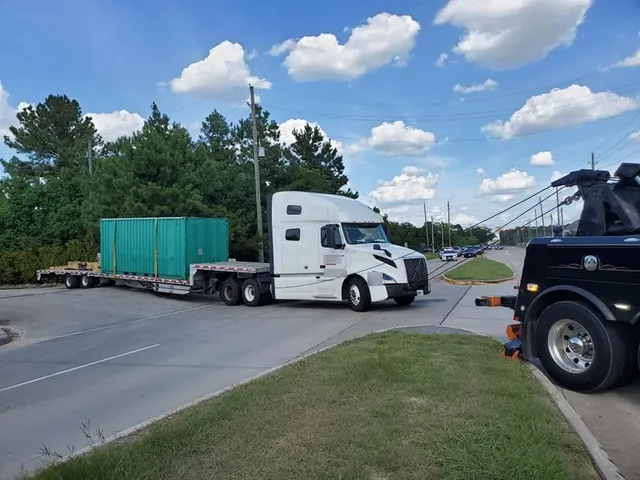
Long-haul trucking is the backbone of commercial transportation, moving goods across states and keeping supply chains running smoothly. But when a semi truck breaks down in the middle of a long route, it can create major delays, safety hazards, and logistical challenges. This is where semi truck towing services play a crucial role.
Professional towing companies use specialized equipment, trained operators, and advanced recovery methods to safely transport large commercial trucks. Here’s a detailed look at how semi truck towing works during long-haul breakdowns.
- Immediate Safety Measures
When a breakdown occurs, the first priority is ensuring the safety of the driver and surrounding traffic. The trucker typically:
- Pulls to the nearest safe location
- Turns on hazard lights
- Uses reflective triangles or flares
- Contacts dispatch or a towing company
These steps reduce the risk of accidents and prepare the vehicle for rescue. Companies rely on semi truck towing from King’s Towing to maintain delivery schedules during breakdowns.
- Professional Towing Dispatch and Assessment
Once a towing service receives the call, they gather key details:
- Truck size and weight
- Trailer type (dry van, reefer, flatbed, etc.)
- Breakdown location
- Mechanical symptoms
- Cargo status
This information helps determine the right type of tow truck—wheel lift, flatbed, or heavy-duty rotator.
- Arrival of the Heavy-Duty Tow Truck
Semi truck towing requires specialized equipment capable of handling large, heavy loads. Heavy-duty tow trucks are equipped with:
- High-capacity winches
- Hydraulic lift systems
- Reinforced booms
- Air brakes connection systems
- Securement chains and towing arms
These tools ensure safe and controlled recovery.
- Securing and Preparing the Semi Truck
Before towing, the operator takes several steps:
- Inspecting the disabled truck for mechanical hazards
- Locking the vehicle’s steering
- Disconnecting the driveline (to prevent transmission damage)
- Securing wheels and brakes
- Ensuring cargo stability if the trailer is attached
These precautions protect both the vehicle and the towing crew.
- Lifting and Towing the Semi Truck
Depending on the situation, the operator may:
Wheel-Lift Towing
Used when the truck can be lifted safely by its axle or suspension.
Flatbed or Lowboy Transport
Ideal for severely damaged or immobile trucks.
Rotator Recovery
Used for rollovers, jackknifes, or accidents requiring heavy lifting power and precision.
Once the truck is secured, the towing operator transports it to:
- A repair shop
- Fleet maintenance facility
- Drop yard
- Or a designated safe area for inspection
- Communication With Fleet Dispatch
Throughout the process, towing operators often update the driver’s fleet dispatch, including:
- Estimated arrival time
- Vehicle condition
- Safety concerns
- Repair shop coordination
This minimizes downtime and helps the business plan for delivery delays or replacement drivers.
- Delivery and Final Inspection
After transport, the tow operator:
- Carefully unloads or positions the truck
- Verifies damage
- Provides documentation
- Ensures the vehicle is safely handed off to mechanics or fleet managers
This completes the towing process with oversight and professionalism.
Semi truck towing during long-haul breakdowns is a highly organized and safety-focused operation. It begins with the driver securing the scene, followed by a towing company assessing the situation, dispatching the appropriate heavy-duty truck, and safely recovering the disabled vehicle. From lifting and securing the semi to coordinating with fleet dispatch and delivering the truck to a repair facility, every step is designed to reduce downtime and prevent further damage. Professional semi truck towing ensures that long-haul operations stay safe, efficient, and reliable—even when unexpected breakdowns occur.
